The first build of Paint Reveal was impossible to lose
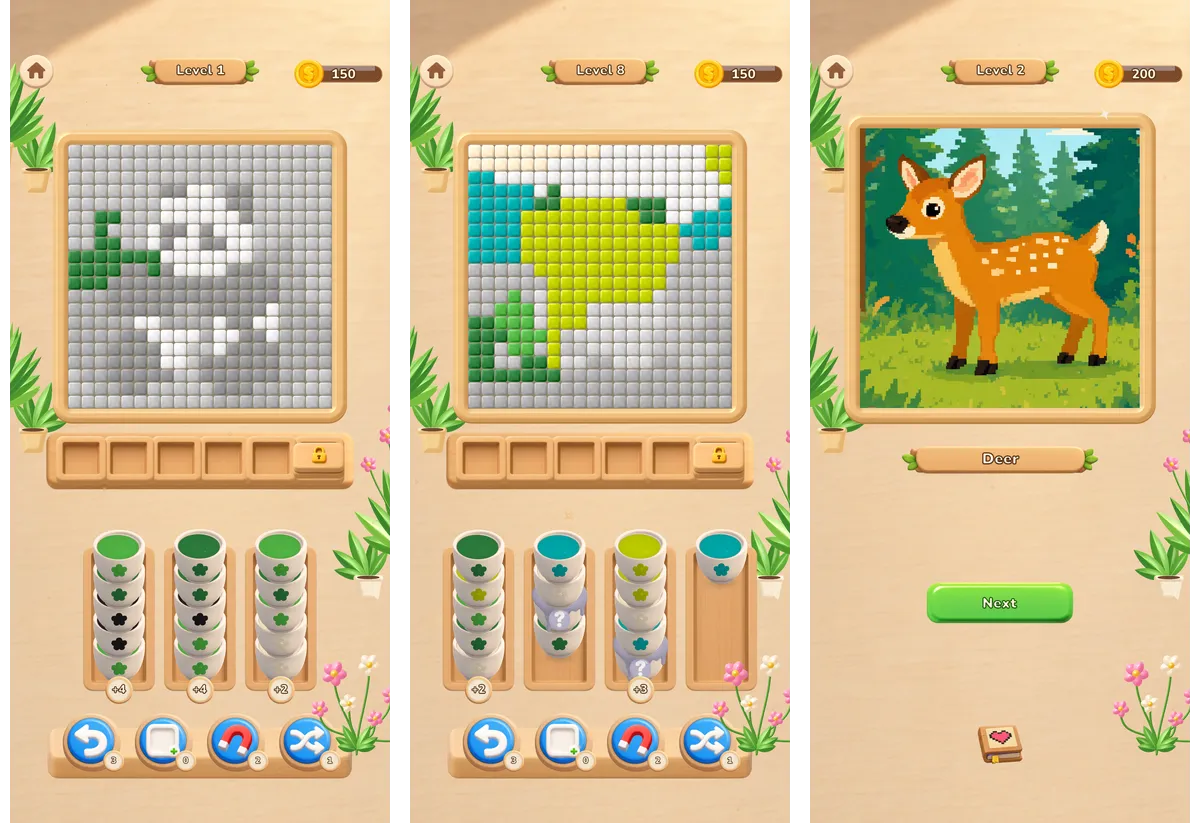
Paint Reveal is a puzzle game I'm working on. There's a grey pixel-art picture at the top of the screen and stacks of paint cups below it. Tap a cup and its paint pours into the squares of the same color. Cups that have nowhere to pour go into one of five holding slots, and if all five fill up, you're stuck. Finish the picture and it bursts into color.
On October 6 the first build went to TestFlight. I installed it and played for a while. My notes from that evening were short: I never lost, I didn't really understand what I was supposed to be doing, and it didn't seem to matter which color I picked.
Checking it properly
A feeling isn't a diagnosis, so I ran the levels through a solver.
The results were worse than I expected. Tapping completely at random won 100% of the time on several levels, including the first three. On medium levels, random taps still won about half to two thirds of the time. A simple greedy strategy, always tapping the cup that can pour the most, won every single level, hard ones included. The holding slots barely mattered, since you rarely needed more than three of the five.
Why
The pictures filled the whole frame, so every color touched the edge from the very first move. Every cup always had somewhere to pour. On top of that, the overflow chains that made pouring look so satisfying were quietly emptying the holding slots for you.
In other words, the game was doing the thinking. Nothing I did had any consequence, which is the opposite of what a puzzle is supposed to be.
What changes
After looking at a few directions, I settled on a new version on October 8. Cups now travel on a conveyor belt around the picture, and they can only paint the squares they can reach from the edge. The belt holds five cups and there are five waiting seats. Order matters now, because a cup sent out too early just clogs the belt.
Levels will also have to pass a stricter test before they ship. A greedy strategy has to lose from medium difficulty upward, random tapping should win no more than about 30% of medium levels, and close to none of the hard ones. If a level doesn't meet that bar, it gets reworked.
I'm also adding a proper tutorial. The first three levels will teach one idea each, mostly with pictures and no more than a line of text, including one scripted near-loss so you see what a jam looks like before it happens for real.
The old rules are still in the code behind a switch, so I can compare them side by side. The next TestFlight build gets the new version, and if it's good, it goes to a wider group of playtesters.
It's a little humbling to make a puzzle game with no puzzle in it. I'm glad I found out on day one of testing and not from store reviews.